The Battle for the
Cloud Backend
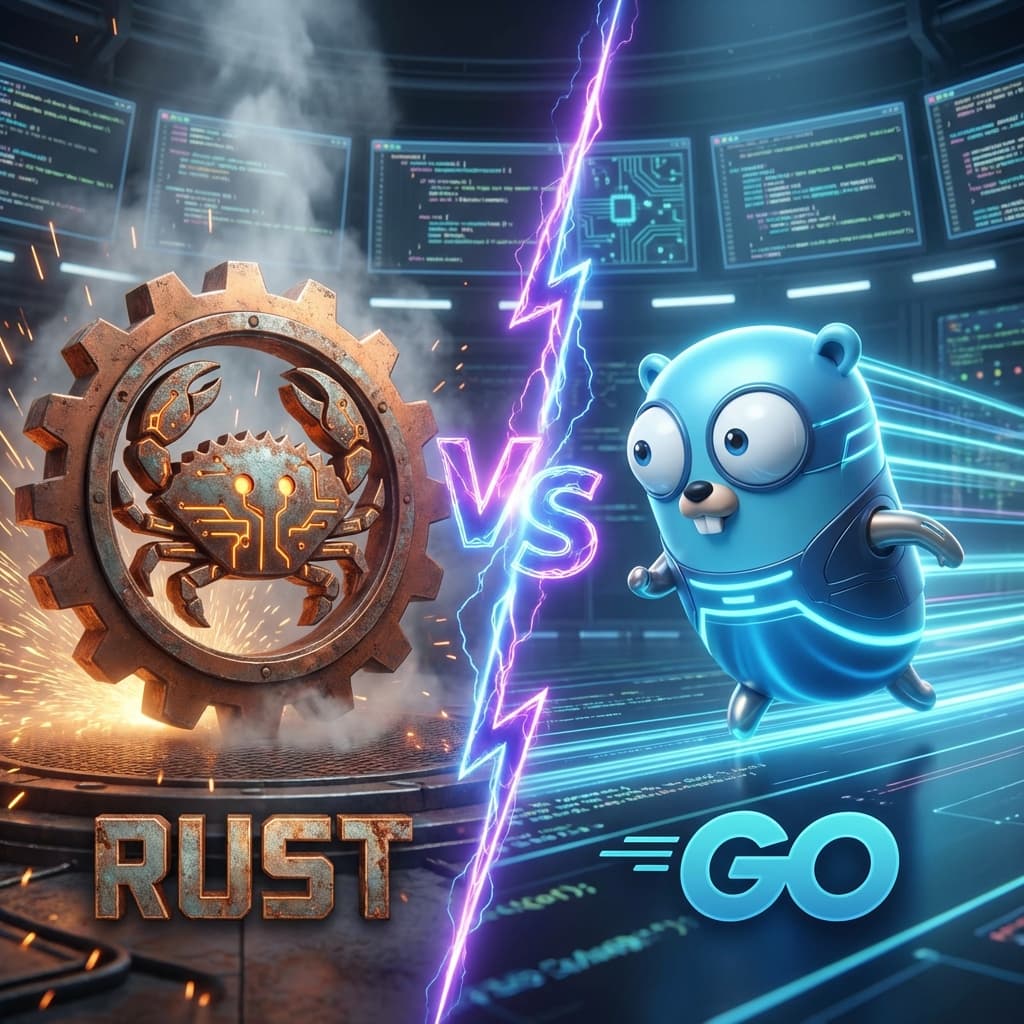
They are arguably the two most important languages of the cloud-native era. Go powers Kubernetes and Docker. Rust powers the Linux Kernel and modern tooling. Which one defines your career in 2026?
Both languages were born out of frustration with C++, yet they took diametrically opposite paths to solve the same problem. Go chose simplicity and concurrency. Rust chose safety and zero-cost abstractions.
1. Philosophy & Memory Management
Go: Garbage Collected
"Good enough" performance for 99% of web apps.
Go uses a Garbage Collector (GC). This means you don't manage memory manually. The runtime pauses execution briefly to clean up unused objects. This is great for developer velocity but introduces latency spikes, making it unsuitable for real-time systems.
Rust: Ownership Model
Predictable performance, steep learning curve.
Rust has NO Garbage Collector. Instead, it uses a compile-time "Borrow Checker." Variables have a single owner. When the owner goes out of scope, memory is freed instantly. This guarantees memory safety without runtime cost.
2. Concurrency: Goroutines vs Async/Await
Go: The Gold Standard
Go's killer feature. You can spawn a "goroutine" (a lightweight thread) by simply adding the keyword go. The runtime multiplexes thousands of goroutines onto a few OS threads. It is shockingly easy to build high-concurrency servers.
// Go Concurrency
func main() {
    go processData() // Runs in background instantly
    fmt.Println("Main function continues...")
}
Rust: Powerful but Complex
Rust uses an async/await model similar to JavaScript, but powered by zero-cost futures. It requires an external runtime (like Tokio). While more explicit and performant, it is significantly harder to wrap your head around compared to Go's "fire and forget" model.
// Rust Concurrency (with Tokio)
#[tokio::main]
async fn main() {
    let handle = tokio::spawn(async {
        process_data().await;
    });
    handle.await.unwrap();
}
3. The Job Market (2025/2026)
This is what you probably care about most.
- Go JobsUbiquitous in backend development. Every startup needing a microservice architecture uses Go. The supply of Go developers is high, but the demand is massive. It is the "Enterprise Java" of the cloud era.
- Rust JobsNiche but high-paying. Rust is used in crypto/web3, high-frequency trading (HFT), game engines, and critical infrastructure. The demand for experienced Rust engineers vastly outstrips supply, leading to significant salary premiums.
2026 Salary Data & Industry Shifts
The job market has evolved since our original analysis. Here's what the latest data shows:
Go — 2026 Avg. Salary
$138K/yr
Strong demand in cloud infra, fintech, and DevOps tooling. Go 1.23 brought ranging over integers and iterator improvements.
Rust — 2026 Avg. Salary
$162K/yr
Soaring demand driven by: Linux kernel adoption, WebAssembly runtimes, and Rust being mandated by the US White House memory-safety guidelines.
Key shift: The US CISA (Cybersecurity & Infrastructure Security Agency) now actively recommends Rust for new systems software, dramatically increasing enterprise adoption and job demand for Rust engineers.
Conclusion: Which one?
Choose Go if: You want to build web backends, microservices, or CLI tools quickly. You value simplicity and fast compile times over raw execution speed. You want the widest availability of jobs.
Choose Rust if: You are building a database, a browser engine, or embedded software. You care about milliseconds. You enjoy wrestling with a compiler to ensure your code is mathematically correct.